
わたしは
[watashiwa]

りんごを
[ringo-oh]
たべる
[taberu]
わたしは___たべる
[watashiwa, taberu]

An object in grammar is the target of an action.
It usually comes with "~를/을".

In "I eat an apple", "an apple" is the object.
In Korean "나는 사과[를] 먹어", "사과" is the object.
In Japanese "わたしはりんご[を]たべる", りんご" is the object.

The Korean object marker "~을or~를" has the same role as "~を" in Japanese.

In En, object comes after the verb, but Ko's and Jp's come before the verb.
It's a different order, but don't worry.

The Object is in the middle in KoJp. The order changes.

"I like cats"
"Cats I like"
"Like I cats"
In Ko and Jp, because they have particles, it makes sense regardless of the order.
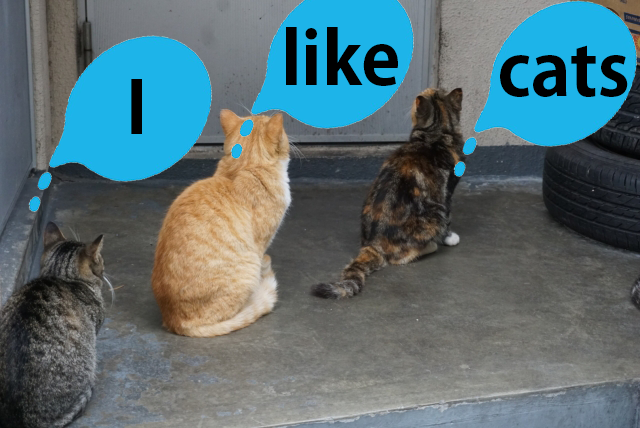
English has no particles, but instead, word order determines the role.
OO(는) OO(does) OO(를)
"I cats like"
->I(는) cats(does) like(를)
->I(는) cats(does) like(를)(X)

You learn naturally!
By repeatedly practicing the basic sentence with an object.

How is it?
It's simple, isn't it?

わたしはピザをたべる
[watashi wa piza o taberu]

わたしはラーメンをたべる
[watashi wa rāmen o taberu]

わたしはパンをたべる
[watashi wa pan o taberu]

わたしはちょうしょくをたべる
[watashi wa chōshoku o taberu]