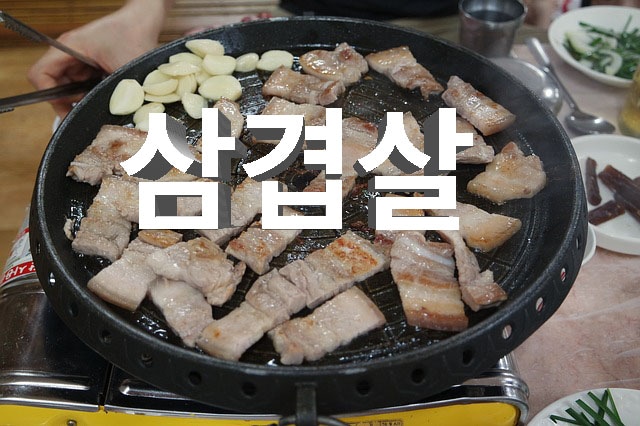
You all know what "Samgyeopsal" is, right?
"Samgyeopsal" is a famous Korean pork dish
that has 3 "layers" (gyeop).
* gyeop = layer

When two consonants come as a final consonant, it is called a double batchim.

Double batchim is the final boss of Hangul, the most difficult part.
It's difficult now, but through repetition, you'll naturally get the hang of it.
You don't need to memorize them. Just take it easy.

First, this is the case where the left consonant of a double batchim is pronounced.

In the case of the double batchim "ㄱㅅ", it is pronounced as "ㄱ".
→ "ㄴ"(n) + "ㅓ"(eo) + "ㄱㅅ"(k) = "넋" (neok)

In the case of the double batchim "ㄴㅈ", it is pronounced as "ㄴ".
→ "ㅇ"(-) + "ㅏ"(a) + "ㄴㅈ"(n) = "앉" (an)

In the case of the double batchim "ㄹㅂ", it is pronounced as "ㄹ".
→ "ㄴ"(n) + "ㅓ"(eo) + "ㄹㅂ"(l) = "넓" (neol)

In the case of the double batchim "ㅂㅅ", it is pronounced as "ㅂ".
→ "ㅇ"(-) + "ㅓ"(eo) + "ㅂㅅ"(b) = "없" (eob)

Next, this is the case where the right consonant of a double batchim is pronounced.

In the case of the double batchim "ㄹㄱ", it is pronounced as "ㄱ".
→ "ㄷ"(d) + "ㅏ"(a) + "ㄹㄱ"(k) = "닭" (dak)

In the case of the double batchim "ㄹㅍ", it is pronounced as "ㅍ".
→ "ㅇ"(-) + "ㅡ"(eu) + "ㄹㅍ"(p) = "읊" (eup)

In the case of the double batchim "ㄹㅁ", it is pronounced as "ㅁ".
→ "ㅅ"(s) + "ㅏ"(a) + "ㄹㅁ"(m) = "삶" (sam)

앉다
[antta]
[アンタ]

많다
[manta]
[マンタ]

넓다
[neoltta]
[ノルッタ]

끓다
[kkulta]
[クルタ]

닭
[dak]
[ダック]

읊다
[euptta]
[ウッタ]

삶
[sam]
[サム]